Saturday, January 2, 2016

Perry Wallace


Perry Wallace was the first African American basketball player to play in the Southeastern Conference. He and his family were from Murfreesboro, Tennessee, but moved to Nashville when Perry was a young boy. Perry attended Pearl High School where he was one of their best players. In 1966, Pearl won the state championship, at Vanderbilt's Memorial Gym. This was significant because they were the first African American school to win a TSSAA state championship. By this time Perry was being recruited by various schools. His top two were Vanderbilt and Kentucky. He liked Kentucky because of the rich basketball tradition, but did not particularly care for their Coach Adolph Rupp. Rupp had been skeptical to recruiting African American players. Vandy on the other hand provided him with the opportunity to play basketball and get a quality education. Wallace was very impressed with head coach Roy Skinner too. Skinner on his visit to the Wallace home, referred to Perry's parents as Mr. and Mrs. Wallace. This was something that was unheard of in the south at that time. This act of respect made an impact on Perry and his family. In the end he decided to go and play his college ball at Vanderbilt. He was able to break down many barriers, but also was the target of racism from several fans and other players and coaches at rival schools. Like at Pearl High, Perry was a great player for the Commodores. Many of his records still stand today both at Vandy, and in the SEC. Today Perry Wallace can be found teaching law in Washington D.C. Thanks to Perry Wallace many minorities now have the opportunity to play athletics across the South.

Perry Wallace in action against the Kentucky Wildcats at Memorial Gym.

Coach Roy Skinner (left) chats with Adolph Rupp before a game at Memorial Gym. Skinner was a Kentucky native.

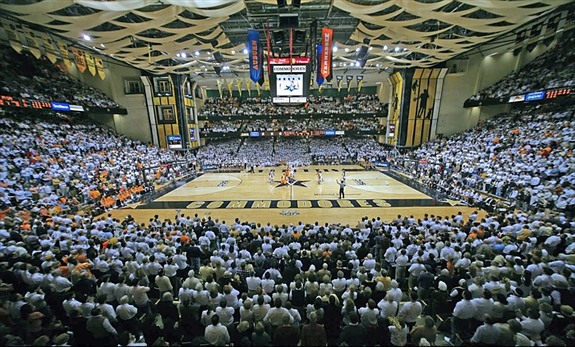
Vanderbilt's Memorial Gym is one of the most historic and unique basketball arenas in the SEC and the country.

Perry Wallace today. He has been the recipient of multiple honors from Vanderbilt and the SEC.

The book Strong Inside details not only the life of Perry Wallace, but also the Civil Rights movement in the South. I highly recommend it.


Stay tuned for more blog posts about tales from Tennessee and beyond. 

Wednesday, December 16, 2015

The Civil War: A true example of Dystopia


This essay was written by me during the Fall 2015 semester, for my Political Satire class. Enjoy!!


     The Civil War was a period in history that was good for some, and bad for others. The argument could be made that this period was a period of dystopia. This means that the political world is one that is decaying. The Civil War period most defiantly supports this idea. The political world was beginning to grow into a dystopia long before the war ever began. This essay will examine some of the reasons that this period in our nation’s history was a dystopia.
     The Civil War began to exhibit dystopian qualities long before the war even started. During the election of 1860, the Republicans led by Abraham Lincoln came out as supporters of the movement to ban slavery. The reason this led to dystopia in American politics is because the South’s electoral votes were basically canceled out in this election. This meant that the Southern states’ votes did not matter. 
     This is dystopia because the political system in the United States is designed to be balanced. By the votes in the South basically not counting, the South felt it needed to leave the Union. This led to a huge breakdown in the United States. It also led to one of the darkest times in our nation’s history. 
     The process of the South leaving the Union involved holding conventions in each Southern state. The conventions were designed to allow each county within the state to vote yes or no, wether of not to leave the Union. If one studies these conventions further  they can find that there was dystopia within each state. Take the state of Tennessee for example. The people of Middle and West Tennessee were in favor of leaving the Union. On the other hand the residents of East Tennessee wanted to stay in the Union. This caused dystopia because the East Tennesseans threatened to separate from the rest of Tennessee and have their own state. Tennessee, as everyone knows, ended up leaving the Union. But one can see that it did not come with out some resistance and dystopia.
     The Kansas and Nebraska Territory also contributed to dystopia within the United States. The question was over the issue of whether or not slavery should be allowed in these territories. Of course the Southerners wanted slavery legalized in these states, but the Northern leaders did not. It basically turned into a war of words, and bringing out old documents and legislation to support each argument. In the end, this led to continued dystopia within the United States. 
     The Civil War also took a toll on the United States economically. It led to a dystopia in the way the economy functioned. The North and South had to completely start from scratch economically. They had to find ways to pay for things such as weapons, ammunition for the weapons, and provisions. The North was able to do this much better then the South was. 
     Dystopia also happened within the politics of both new governments. This was especially true for the South. Unlike the North, the South had no high ranking political officials in place. They had to appoint people to fill these roles. This led to dystopia, because they had to breakdown their existing government structure in order to make a new one. There most defiantly was backstabbing and bribery going on within the Confederate States of America. 
     Much like in Jonathan Swift’s Gulliver’s Travels, the South underwent major changes in how their soldiers and other residents behaved and were, and are still being portrayed. They were thought of as being nothing more then savages who were out to kill. This idea can be supported since the South was noted for their guerrilla warfare. Men such as Champ Ferguson, William Clarke Quantrill, and John Singleton Mosby, are just a few examples of the savagery and dystopia in Southern society during the Civil War. They were also thought of as being savages in the sense that they were upholding a savage institution. The common person then, and even now struggled to wrap their mind around how and why the South and the people that resided and fought for it could uphold such a savage practice like slavery.
     Continuing along this same line, prison camps also had qualities of the savagery that was portrayed by Swift. These camps were seen in both the North and the South. The most notable camps were Elmira for the North, and Andersonville for the South. Prisoners of War were sent here and while imprisoned they were treated like animals. What is most disturbing about this whole thing is that Americans were doing these horrendous things to fellow Americans. What made these camps even more brutal and savage, was the trades and cartels that went on. The most notable one was the Dix-Hill Cartel. This involved the exchange of prisoners of war between the North and the South. This is yet another example of the dystopia that was occurring in United States society during the Civil War.
     One other example of dystopia during the Civil War was the breakdown of families. There were many cases of families being ripped apart over the issue of slavery, and what side to join. Take the case of the Ferguson family as an example. Champ Ferguson, who would become known as one of the South’s most notorious guerrilla fighters, was the only person in his family to side with the Confederacy. The rest of his family sided with the North. When Ferguson left home to go off to war, it would be the last time he would see his family. 
     Most of these examples of dystopia could be seen in the border states, such as Kentucky, Maryland, and Missouri. There were also examples of dystopia among families in the Kansas-Nebraska territories. There were also cases of men sleeping with their slaves. This only happened in the South, of course, but still led to the breakdown of families. One can also look at the many slave auctions that occurred throughout the South and see dystopia. Families were broken up, husbands were separated from their wives, and children from their parents. It was just a horrible event that took place. This is just one of the many examples of dystopia that occurred during the Civil War. 
     Both sides were extremely brutal to each other as far as economics went. Both the North and the South used their navies to set up blockades. The goal was to prevent anything from being imported, and anything from being exported. For the most part these blockades were successful. Many individuals lost money as a result of this practice. This was just another tactic used to attempt to destroy one side or the other. 
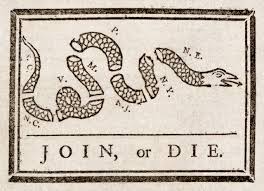
     Quite possibly one of the most famous pieces of satire that relates to the Civil War, was the “Join or Die” posters that were used to recruit soldiers. Basically what these posters were saying was that if you do not join, then you will die. In other words you better join the military in order to protect yourself. This led to many men both young and old deciding to enlist. Many of these men did not know what they were getting in to. For many it was their first time away from home. This led to a rise in desertions. By having men desert, the military’s numbers went down, causing a loss in manpower. For the Confederacy, this was especially true. The South were already sort of an underdog, and desertions did not help them out any. Many of these men and boys either went back to their homes, where they took on new identities, or they joined bands of guerrillas like Ferguson and Mosby. When these men, deserters or not, returned home after the war, they were faced with disorders like Post Traumatic Stress. The process of the dystopia of society was still in full force.
     By the time the Civil War was over, there was a complete dystopia of society in the United States. This was especially true for the South. Major cities such as Charleston and Atlanta were left in ruins. Nashville was now entirely controlled by the Union. Multiple people had either been displaced, or had their property stolen or destroyed. Multiple people were living on the streets. Farmers and businessman who had once been very well off were now left with nothing. The term “war zone,” could never have been more appropriate. Much like in “The Hunger Games” movie, society after the Civil War was extremely dark and grim. 
     Another problem that the United States was facing was the issue of how to become united as one once again. There were people in favor of this, and there were people who were not. The most notable example of this was John Wilkes Booth. Booth felt that the South had not been given a fair chance. He felt that the South needed to rise again, and try and make another attempt to win the war. He blamed all of this on one man, none other then Abraham Lincoln, the sixteenth president of the United States. Booth went so far that he assassinated the president. The dystopia of society went so far that the nation’s leader had to die. 
     The Reconstruction Period in the United States showed just how much of a dystopia the nation had become. The states that had seceded were forced to reapply for state hood. After they did that and were accepted, they had to be reseated in Congress. The United States government was responsible for all of this. The Southern states had no say in who they could or could not choose to lead them. Reconstruction was also designed to deal with the economic ruin that the South found themselves in. The United States government wanted the South to be able to support itself once it was readmitted to the Union. They also wanted to assist those who had been indirectly affected by the war. The United States government was serious about getting out of this dystopian state. One can see from studying Reconstruction, that it takes much hard work to rebuild a country and get it out of a dystopian state.

     As one should be able to see, the Civil War was a terrible time for our nation, and the people residing here. It is one of the many examples of a dystopian society throughout our nation’s history. The United States, during the Civil War, had some of the same political satire and dystopian qualities that were illustrated in Swift’s Gulliver’s Travels, and “The Hunger Games.” The factor that makes the Civil War stand out from any other war in the history of the United States is the fact that it involved the division of our nation. It involved, in some cases, brother versus brother. Looking back on it years later, one has to think, was the war really worth it? Both sides lost numerous people, for what? The people believed in what they were fighting for, but one must wonder if they thought it would have such serious and deadly consequences. The Civil War was truly a time of dystopia in the United States. 

I made a reference in my essay to the Civil War and the Hunger Games. It was basically fight to the death, family against family.

Above is a picture of the "Join or Die" political cartoon.


Stay tuned for more blog posts about tales from Tennessee and beyond.

Monday, August 17, 2015

Gunfight at the O.K. Corral


The Gunfight at the O.K. Corral was one of the Old West's most famous conflicts. The skirmish only lasted 30 seconds, but the build up took much longer. The issue that had been brewing for some time was a feud between the Earp men, and the Clanton cowboys. The two sides had been involved in a fight earlier and the effects were still being felt by both sides. The Earp brothers and Doc Holliday were lawmen who were looking to keep the peace and drive the troublesome cowboys out of Tombstone. The Clanton cowboys had been working on local ranches, illegally buying and selling cattle. This did not sit well with the Earp boys, as they were looking to rid Tombstone, and the surrounding territories of all illegal activity. To sum this all up, Ike Clanton was brought in on charges of cattle rusting, which he was able to beat. Later on in September 1880, there were a series of stage hold ups. Frank McLaury was arrested for the stage hold ups. This made all the cowboys mad, and they vowed to get back at the Earps for persecuting the cowboys. The first thing that the cowboys did was to attempt to frame Doc Holliday for the robberies. His girlfriend Big Nose Kate was bribed into telling the local judge that Doc was indeed responsible for the stagecoach robberies. Fortunately for Holliday, the Earps were able to find witnesses that said none of this was true. On the eve of the shootout, Ike Clanton, and Doc Holliday got into a fight. Nothing happened as Morgan Earp was able to intervene quickly. On the morning of the fight, both sides were gambling and drinking. Ike Clanton was set for trial for the assault on Doc Holliday. When the cowboys arrived in Tombstone, they refused to disarm. The two sides met in an alley, where Virgil Earp attempted to disarm the cowboys again. The cowboys instead pulled their guns on the lawmen. This caught the lawmen by surprise because the were not expecting a fight. The first to fire was Billy Clanton, but he missed. Frank McLaury aimed his gun at Wyatt Earp, but Wyatt drew faster and shot McLaury in the stomach. Ike Clanton ran and grabbed hold of Wyatt Earp, saying that he was unarmed and wanted no trouble. He then ran away unharmed. Morgan Earp latter fired hitting Billy Clanton in the wrist. Clanton then got back to his feet, and he and Frank McLaury fired on Morgan Earp wounding him. Morgan and Doc Holliday were able to return the fire and finish McLaury off. By the time the fight was over, Billy Clanton and Frank McLaury were dead. Morgan and Virgil Earp were wounded, but would survive. The only ones to come out of the skirmish unscathed were Wyatt Earp and Doc Holliday. After the skirmish was over the bodies of the three deceased cowboys were put on display in Tombstone for all to see. The battle made the Earp brothers and Doc Holliday famous and men to be feared. These 30 seconds would be vital in determining how the west was won. The Gunfight at the O.K. Corral, while a small battle, still has big implications.

Above is a picture of Wyatt Earp.

Above is a picture of Virgil Earp.

Above is a picture of Morgan Earp.

Above is a picture of Doc Holliday.

Above is a picture of Ike Clanton.

Above is a picture of Billy Clanton.

Above is a picture of the bodies of Frank and Tom McLaury, and Billy Clanton on display at Tombstone. 


Stay tuned for more blog posts about tales from Tennessee and beyond.

Monday, August 10, 2015

Kit Carson


Kit Carson was an American Frontiersmen, mountaineer, and a soldier in the U.S. Army. Carson left his Missouri home at the age of sixteen, to join an expedition led by John C. Fremont. He became a wilderness guide under Fremont, and together the two of them would become two of the greatest frontiersmen in American history. He and Fremont would also fight in the Mexican-American war, and later in his life Carson would lead a Mexican regiment during the Civil War. Kit went throughout the wilderness during the early nineteenth century looking for furs. The most specific type of furs that he looked for was beaver. The money was hard earned, as Carson had to haul the heavy furs himself until he could get to a town or trading post in order to collect his money. Carson also had to scavenge for food, and nurse himself when he was injured. Carson spent much time looking out for Indians, as well as grizzly bears. From 1842-1848, Kit Carson made three expeditions with John C. Fremont. These expeditions took them through the states of Utah, Oregon, and California. On the third expedition, Carson and Fremont were involved in the Bear Flag Revolt. The Mexican government had ordered all Americans out of California. Fremont and Carson helped to put down this revolt and the American settlers were allowed to stay in California. During the Mexican-American War, Carson was tasked with guiding Stephen Kearny and his men from Socorro, New Mexico to San Diego, California. Kearny and his men were ambushed on the way there, but thanks to Carson around 200 American reinforcements arrived and they were able to make it to San Diego. During the Civil War, Carson and his band of fighters were tasked with terrorizing the Indians and driving them out of their lands. The group that was terrorized the most were the Apaches. Kit Carson despised the Apaches, and he wanted to get rid of them in any way he could. Kit also fought against the Navajo Indians during the Civil War. The most notable battle that Kit Carson was involved in was the Battle of Adobe Wells. Carson was successful in all of these Civil War activities. Kit Carson truly was an American legend, and his legacy still lives on to this day.

The above picture is of Kit Carson and his horse Apache. The horse got its name from the Apache territory that Carson rode in and explored.

Above is a picture of John C. Fremont.


Stay tuned for more blog posts about tales from Tennessee and beyond.

Thursday, August 6, 2015

Billy the Kid


Billy the Kid, also known as William H. Bonney, was one of the 19th centuries' most notorious outlaws. He was a very skilled gun men, and he terrorized the old west area of the United States, becoming one of the most wanted men in the United States at the time. Billy was known for his participation in the Lincoln County War. Not much is known about Billy's childhood. Not much was known about his early life until Lew Wallace, the governor of New Mexico, put a bounty on his head. The first type of crimes that Billy committed involved horse thievery. On August 17, 1877 Billy the Kid committed his first murder. He was seventeen years old when the murder occurred. The murder happened in Tucson, Arizona near the army camp known as Camp Grant. The victim was a soldier by the name of F.P. Cahill. The shooting had started out as a common fight, but turned deadly when Billy turned a gun on Cahill. After the murder, Billy fled to Lincoln County, New Mexico. Billy went to work in a cheese factory, but became thrust in the middle of a war between merchants. In response to this, Billy formed a posse, known as The Regulators. The goal of this posse was to put down this rebellion once and for all, and settle the score with those who they did not like. The Regulator's fuel was fired when one of their men, known as Frank McNab was killed. They led an assault on the town of Lincoln, where they took defensive positions. Only a few shots were traded, and The Regulators were forced into retreat and eventual hiding. The pursuit of Billy the Kid and The Regulators picked up when New Mexico governor Lew Wallace put a bounty on his head. This led to many valiant, yet unsuccessful attempts to capture Billy and his gang. It was not until Pat Garrett, the new sheriff of Lincoln gained his office that Billy the Kid would be brought to justice. Garrett and his posse were able to locate and corner The Regulators in an abandoned house near Stinking Springs. They had to wait until morning in order to make their next move. Billy the Kid eventually came out and challenged Garrett to a gun fight. The two men exchanged words, but Billy eventually surrendered and ate his breakfast. Billy the Kid was taken to a prison in Santa Fe. He was tried in Mesilla, and on April 9, 1881 he was sentenced to hang. The execution was scheduled for May 13th. Billy was placed in the Lincoln County Jail. While there he was tormented by other inmates. On April 28, Billy the Kid escaped. On his way out he made sure to kill the guards, and other inmates who had bullied him. It is unclear how he got a gun however. Once outside he got on a horse and rode out of town. The horse would return a few days later. Pat Garrett and his posse went after Billy. They tracked him to the home of Pete Maxwell, who had been a friend of Billy's. Billy unbeknownst to him, walked right into the room where Garrett was hiding. The room was dark and Billy had no idea that he had just walked to his death. Garrett fired and Billy the Kid was dead. One of the Old West's most notorious outlaws was dead.

Above is a picture of Sheriff Pat Garrett.

Above is a picture of the Lincoln County Courthouse and Jail. Billy the Kid escaped from here.

Billy the Kid's headstone located in Fort Sumner, New Mexico.


Stay tuned for more blog posts about tales from Tennessee and beyond.
Thursday, May 28, 2015

The Restoration Movement


The Restoration Movement occurred during the Second Great Awakening. The movement lasted from 1790-1840. The goal of the movement was to "restore" the church back to New Testament principles. The movement was led by three men. They were Barton W. Stone, Thomas Campbell, and Alexander Campbell. These three men were former Presbyterian Ministers. The teachings that they would be responsible for would lay the foundation for what would come to be known as the church of Christ. Some of the things that they believed were no women leading worship, no instruments in worship, Lord's Supper on the first day of the week, among various other things. The Restoration Movement became very popular. The most famous meeting was at Cane Ridge, Kentucky, in 1801. The goal of this meeting was to spread the "good news" and hopefully convert people. By the time the meeting was over, around 800-1,100 had taken communion. The meeting was largely led by Stone, who was the more liberal of the three men. The two Campbell's goal was to interpret the Bible as close as possible. They came up with the idea of Baptism by immersion, as well as the idea of acapella singing in worship services. In the end this movement led to the creation of the church of Christ. Stone's ideas became known as the Disciples of Christ. In the end, these men were able to do great things, and they helped to restore religion in a nation that was still trying to find its way. I am very happy to say that I am a member of the church of Christ. The history of how we came to be is priceless.

Above is a picture of Barton W. Stone.

Above is a picture of Thomas Campbell.

Above is a picture of Alexander Campbell.

Inside of the Cane Ridge meeting house.

Alexander Campbell home in Bethany, West Virginia.

The East Main Street church of Christ (pictured above) in Murfreesboro, Tennessee, is one of the oldest churches of Christ in the state of Tennessee. It was established during the Restoration Movement, and both Thomas and Alexander Campbell preached sermons at this congregation. During the Civil War the church was transformed into a field hospital during the Battle of Stones River. Eventual president James Garfield worshipped at the church, serving as song leader. This is one of many instances where the Civil War and the Restoration Movement overlap. My two favorite periods in history.

For more information on this story, check out this article in Murfreesboro's "Daily News Journal:" http://www.dnj.com/story/news/local/2015/04/18/east-main-street-church-christ-offers-rich-heritage/26010749/


Stay tuned for more blog posts about tales from Tennessee and beyond.

Monday, May 18, 2015

Andrew Jackson and the Battle of New Orleans


The below blog post is a research paper that I wrote this past semester (Spring 2015).


The Battle of New Orleans was the last major battle of the War of 1812. The battle actually took place after the conclusion of the war. This battle was significant because it put down the British threat once and for all, and it also made Andrew Jackson a household name. This paper will examine the battle. It will look at the events leading up to, during and after the battle. This paper will also examine how this battle made Andrew Jackson a household name, and paved his way to the White House.
     The War of 1812 had been fought as America’s second war of independence from Britain. The war was primarily made up of naval engagements. There were a few battles however that were fought on land. Andrew Jackson of Tennessee was one of the leading generals during the war. Jackson had a personal vendetta against the British. Many accounts state that Jackson and his brother had been captured by the British as young scouts during the Revolutionary War. While in captivity he and his brother were beaten. Jackson’s mother came to plea for the release of her sons, but to no avail. Jackson’s mother and his brother later contracted a disease from the British and passed away. Jackson never forgave the British for this.
     Andrew Jackson was primarily an Indian fighter during the early stages of the War of 1812. Jackson and his men did much of their fighting in the southern region of the United States. This region is now made up of Mississippi, Alabama, and Georgia. Jackson and his men’s biggest victory against the Indians was at Horseshoe Bend. This skirmish took place in present day Alabama. The Indian tribe that was involved in this skirmish were the Red Stick Indians. By the time the battle was over, the American forces, led by Jackson, had routed the Red Stick Indians. The Indians were forced to sign the Treaty of Fort Jackson, which gave all their lands to the United States government.[i] Andrew Jackson was quickly establishing himself as a very capable military general.
     After the Battle of Horseshoe Bend, Andrew Jackson and his men continued their trek southward. They eventually reached Florida and the town of Pensacola. This battle was fought against the Spaniards. The goal of this battle was to attack the Spanish and force them to help the United States drive the British out of Florida. If they did not agree to this, then they would be routed. Jackson sent a couple of scouts out to see how imposing the Spanish forces really were. The scouts came back and gave the United States Army permission to attack. Jackson and the American forces charged, but they did not kill anyone. Instead they just captured and forced all the Spanish people that were in Pensacola to leave the city. Jackson and his army told the Spanish people that the only way that they could go back to their city was if they agreed to help the United States to get rid of the British. The Spanish refused so Jackson took off further south.[ii]
     After the failed attempt at Pensacola, Jackson and his men moved southward to Mobile, Alabama. The British Navy had been spotted at the port in Mobile. Jackson and his men were hoping that they could capture the navy and prevent them from reaching New Orleans. When the United States forces got to Mobile, the British were nowhere to be found. Jackson decided to appeal to a local band of pirates for help. The pirates told Jackson that the British were indeed heading for New Orleans.[iii] This is what Jackson and his men had feared. The battle that would occur would become the most famous battle of the War of 1812.
     While all of these events were occurring, the United States and the British were negotiating a treaty in Ghent, Belgium. This treaty would end the war, but really did nothing else other than that. Jackson and his forces were unaware of these negotiations. They continued their march toward New Orleans to stop the British. Jackson wanted to prevent the British from taking New Orleans and having direct access to the Gulf of Mexico and the Mississippi River.
     Jackson and his men were welcomed with open arms upon arriving at New Orleans. William Claiborne and Edward Livingston were already stationed in New Orleans. Both of these men had been working tirelessly to ward off British attempts to invade the city. Claiborne and Jackson were fellow Tennessee residents and lawyers and had been in contact with each other for quite some time. Jackson and Claiborne decided to use free blacks to help in their fight against the British. Around three to four hundred free blacks enlisted in the United States Army. They were put in the same regiments as regular American soldiers.[iv] This would prove to be a very effective decision. 
     The three men thought that the most logical point of attack for the British would be a water route that ran from the Gulf of Mexico to Lake Borgne as well as Lake Pontchartrain. In order to protect this path, five gunboats were stationed at the opening of the pass. There was also a sandbar that was put in place to protect this path. The sandbar made sure that no ships that were over five draft feet could get through. Most of the British ships were larger than the five draft feet, so they were unable to get through.[v]
     The next fortifications that the United States forces had to make to protect the city of New Orleans were the roads. In order to properly fortify the roads, troops were stationed along the roads leading into and out of New Orleans. The thing that concerned Andrew Jackson and his troops was that they did not know which way the British would come into the city.[vi] They had to leave everything up to blind chance.
     Before the British arrived, Jackson appointed Edward Livingston his aide and confidential advisor. Livingston was put in charge of all the New Orleans defenses. Livingston was suited for this job because he spoke fluent French and could communicate effectively with almost anyone. After Jackson appointed Livingston as commander, he went out and made sure that every possible way to access the city was properly fortified. Livingston took his new job very seriously. The relationship between Livingston and Jackson would become a lifelong one. [vii]
     The next area in which Jackson focused on was the geography of the city of New Orleans and the land surrounding the city. He wanted to know how many rivers, mountains, valleys, and the list can keep going, that the British were going to be facing. Jackson was determined to have the advantage in this battle. In order to do this Jackson enlisted the help of Major Howell Tatum as well as Arsene Lacarriere Latour. Together Tatum and Latour took Jackson around the city and the surrounding area and showed him every single detail of the region. The two men also provided him with maps of the land that proved to be beneficial to him. [viii]
     After touring the land in and around New Orleans, Andrew Jackson ordered that all roads as well as waterways should be blocked. To do this he ordered trees to be placed in the middle of these access points. He also ordered batteries to be placed at each point of access to help fend off any threat that might come their way. Soldiers were also enlisted by the United States Army as spies. They were not as experienced as the spies that had been serving in the Creek War, but they were still able to do the job.[ix] Andrew Jackson was now ready for battle with the British.
     On December 14, 1814, the British officially arrived on American soil. The British forces, led by Nicholas Lockyer landed at Lake Borgne. When they got there they were met by the United States navy, led by Daniel T. Patterson. The American navy was much smaller than the British navy, but they were able to hold their own in this battle. In the end, the United States navy lost. This loss very much alarmed Andrew Jackson and his men, as well as the citizens of New Orleans. [x]
     After learning of the British victory at Lake Borgne, tension in the city of New Orleans was extremely high. In a December 15, 1814 article addressed to the citizens and soldiers in New Orleans, Thomas L. Butler vowed to deal with the British accordingly. The letter was written in an effort to encourage or pump up the citizens and the soldiers who were in New Orleans. Butler told these people to use every ounce of energy that they had and be patriotic. He said by doing this they could protect their family and property.[xi] This article helped to encourage the people who were in and around New Orleans. It boosted their confidence and moral.
     After the navy defeat at Lake Borgne, Andrew Jackson knew that he would need more troops in order to compete with the British. He called on his home state of Tennessee to send volunteer troops to New Orleans to help him out. Jackson’s home state responded to this plea by sending around 2,000 troops to New Orleans. These men mixed in with others that came, plus the men already there led to a great army for Jackson. An army that had been outnumbered now had around 5,000 men.[xii] The United States was now ready to go to battle with the British.
     In order to strengthen the United States navy, Edward Livingston decided to enlist the help of the Bartarian Pirates. The Pirates had already been offered a position in the British Navy, but had refused. These men had great knowledge of the seas and the weapons needed to win this battle. The leader of the Baratarian Pirates was Jean Lafitte. Lafitte had destroyed a United States naval base earlier during the War of 1812. He was facing legal trouble as a result. Livingston took advantage of this in convincing the Pirates to join the navy. Livingston said that he could get them acquitted of their charges, if they agreed to join forces with the Americans. Lafitte and his men agreed. Andrew Jackson was not very sure about this, but Livingston told him that they would be an asset. [xiii]
     By January 7, 1815, both the Americans and the British were ready for battle. Both sides had over 10,000 troops that were involved in this battle in one way or another. Most of these men would not see any action on the east bank. The British were led by General Edward Pakenham. Pakenham’s main goal was to attack the east bank. He had around 5,000 men along with four 24 pounders, reinforced further by four 18 pounders. Jackson had around 4,700 men made up of eighteen batteries that had one 32 pounder, three 24 pounders, and also two 18 pounders. Jackson also had reinforcements that he could count on to help him.[xiv] Both sides were very even, but each side had advantages. The Americans had an advantage because they had done much scouting and knew the lay out of the land. The British had the advantage thanks to their well-trained army and navy. By the end of the war these advantages would come into play, but not in the way one would expect.
     The British were the first to attack. They chose to attack on the east bank of the river, near the Rodriguez Canal. Jackson new this was going to happen because he had scouted the British’s tendencies, and had also received some intelligence from British deserters. The attack on the east bank occurred on January 8, 1815. During the course of the attack, Jackson rode up and down the line on his horse encouraging his men. He eventually stopped near the center of the line, where he could have a bird’s eye view of all the action. In order to keep the morale of the battle high, Jackson ordered music to be played continuously. The American forces were able to prevail on the east bank. This was due in large part to the lack of support of the British. The British had stationed too many troops on the west bank of the river, and these reinforcements were unable to get there in time. The British also suffered quite severe casualties. General Samuel Gibbs was shot and killed; Edward Pakenham was also shot in the knee and killed. The entire attack lasted about an hour and a half.[xv]
     While all of this fighting was occurring, the United States and the British were engaging in a skirmish on the west bank of the river. Unlike on the east bank, things went much better for the British. As soon as the British landed on the west bank, they saw gunfire. They were able to make quick work of the Kentucky and Louisiana militias. These men were untrained and had little to no artillery with them.[xvi] The west bank was a complete role reversal for the British, as they were able to rout the Americans. 
     In the end, the Battle of New Orleans was a “glorious victory” for the United States. The British had a reported 2,037 casualties, whereas the Americans only had seven killed and six wounded. Among the British forces, the most notable casualties were generals Pakenham, Gibbs, Dale, and Rennie. It is noted by many historians that American troops went around and dismembered the bodies of these British generals.[xvii] Jackson was very happy to report back to President James Monroe of his victory at New Orleans. He told of his victory at New Orleans in a January 9th letter to the president. In this letter he told of the actions of his troops. He also praised the way in which they fought. Jackson told Monroe that he did not think that the British would be a threat, but they could not afford to let their guard down. [xviii] This proved to be a good strategy, as the British would make one more attack on the Americans at Fort St. Philip. This was a last gasp effort for the British to gain access to the Mississippi and then invade New Orleans.
     After the fighting on January 8th, the British were feeling regret for leaving the west bank of the river. The British’s last effort would be sail down the Mississippi River and sneak behind the lines of Andrew Jackson and take New Orleans. The only obstacle to the British plan was Fort St. Philip. The fort was heavily armed and fortified. After the victory on January 8th, Andrew Jackson and his men had gone to the fort. Once Jackson arrived he inspected the fort to make sure that it would be able to withstand an attack by the British. Jackson saw the need for more troops to be brought in, so he did so. He enlisted the help of some local slaves to build gun emplacements.[xix] By doing all of this the fort became stronger than the British thought it would be.
     The United States army stationed two companies of troops at Fort St. Philip. There were a total of 406 soldiers as well as sailors at the fort. This battle would primarily be fought on the waters.[xx] The United States had the advantage, thanks to having a navy with experienced generals. By having this, the United States was able to make up for their navy being rather small.
     The plan for the British, following the capture of the fort, was to take the United States fortification at English Turn. The British knew that if they could get the fort, then they could make up for their defeat earlier and still be able to take New Orleans. The British, like the Americans, were extremely confidant in their navy and felt like that they had the advantage.[xxi]
     The first step that the British needed to make was to blockade the Mississippi River. This would prevent any unwanted ships from passing through. Finally on January 9th at 11:30 in the morning the Americans spotted two British ships. The two ships were trying to figure out how deep the waters were. The United States forces immediately sprang into action. They began to fire their cannons, forcing the ships to turn back. The United States forces took their positions in the fort as soon as the cannons were fired.[xxii] The final attack at the Battle of New Orleans was on.      
     A few hours after the first shot was fired, a somewhat heavy rain began to fall. At approximately 3:30 in the afternoon, the British took their position behind a bend in the river. This position was about 3,960 yards from the fort. The British forces were the first to fire. They fired a total of four sea mortars at the Americans. The United States forces were somewhat concerned because the British troops were out of range. Despite this obstacle, the American forces still maintained their position at the fort[xxiii]. This would prove to be a great move by the United States.
     Fighting continued for the next three days. It was more of a game of cat and mouse. The British would fire a shot, and then the United States would answer. The weather did not help matters for either side at all. It rained every day that the battle was being fought. The only time the two sides ceased fire was to have lunch and dinner. By January 16th the fortunes of the Americans changed. The rain ceased, and with it, the morale of the American forces grew.[xxiv] They now felt like they could win this attack.
     While all of this was going on at Fort St. Philip, Andrew Jackson was at Chalmette. He was able to hear the cannon fire at the nearby fort. He knew that he had to do something. He decided to begin cannonading of the British line. He felt by doing this, he could harass the British, and force them to flee. This did indeed drive the British crazy. It is noted that many British deserters told the Americans that Jackson’s cannonading kept the British forces up at night and made them irritable.[xxv] Based on this information, Jackson could be considered the first modern day sniper.
     The United States forces began an effort to encourage British troops to desert. They particularly targeted the British sentinels. They used the promises of land and money to sway their decisions. One British general noted that within a week, there were many men who quit the British military and sided with the United States.[xxvi]
     A few days later, the American forces forced the British to evacuate their ships. The vessels were set on fire, and the men on board were captured. The British were trapped. They were running out of supplies, and there were no reinforcements that could get to them.[xxvii] The British were beat, and they knew it. The Americans, led by Andrew Jackson were overjoyed to have defied the odds and won this battle.
     In a January 25th letter to President James Monroe, Andrew Jackson told of all the exploits that occurred during this final attack. He praised his men for their prowess and said that thanks to their incredible confidence, and love for their country, they were able to win the war. He said that each of his men were entitled to merit for their efforts during the entire battle.[xxviii] It is noted by many historians that there was a great outbreak of pride and patriotism in Washington after learning of the American victory at New Orleans. Andrew Jackson was now a hero.
     The Battle of New Orleans ended a fourteen month run that Andrew Jackson had had where he had not lost a single battle. The Battle of New Orleans would be the last battle that Jackson would ever fight. One of the factors that historians believe caused Jackson to be so successful is that he had a really good grip on strategy and tactics. Jackson never read any “how to” manuals, instead he relied on common sense to help him be successful on the battlefield. Jackson also was a master when it came to battlefield tactics. He could deploy his men in battle in a way that gave him a good chance to win.[xxix] All of these factors and more led to Andrew Jackson becoming one of the best generals of the War of 1812.
     After his service in the War of 1812, Andrew Jackson decided to enter politics. On April 6, 1815, Jackson, his wife Rachel, and their young son left New Orleans for Nashville.[xxx] As far as politics go, Jackson was the winner of The Battle of New Orleans’s political legacy. He became the leading political figure of postwar America.[xxxi] This would continue to be the case until 1829, when he was elected president of the United States. Jackson served in this role until 1832. He went from being nothing more than a country boy from Tennessee to the President of the United States. All of this was accomplished thanks to his amazing heroics and exploits at the Battle of New Orleans. Andrew Jackson will forever be known as The Hero of New Orleans.

Above is a picture of Andrew Jackson.

Above is a picture of Edward Pakenham.

Above is a map of The Battle of New Orleans.

The book The Battle of New Orleans, by Robert Remini was very vital to me throughout my research process. Book is highly recommended.

The book Glorious Victory, by Donald Hickey was also vital for me in writing this paper. It is the newest book published about the Battle of New Orleans, and comes highly recommended because of the author.


Stay tuned for more blog posts about tales from Tennessee and beyond.