Thursday, September 8, 2016

White Plains


The White Plains plantation is located in Algood, TN which is just a few miles outside Cookeville. The plantation was established in 1909, by William Quarles. The original plantation was like a small town. There was a general store, blacksmith shop, and post office. Quarles was a veteran of the Revolutionary War, who had migrated to Tennessee from Virginia. The plantation served as a stagecoach stop along the Walton Road. Three U.S. presidents stayed at the plantation, Andrew Jackson, James K. Polk, and Andrew Johnson. Quarles was murdered in 1814 by William Phillips. The plantation was passed on to Stephen Decatur Burton, who built the current structure in 1848, when the original home burned. Burton lost most of his money after the Civil War, when Union forces burned cotton warehouses in Chattanooga. The plantation was eventually sold and later developed. The house and the property it sits on are currently privately owned. The White Plains home is considered to be one of the oldest homes in Putnam County, and is listed on the national register of historic places.

The outbuildings at the White Plains plantation are the only remaining original structures.


Stay tuned for more blog posts about tales from Tennessee and beyond. Remember to check out the section of the blog devoted to Moore Historical Consulting.

Sunday, September 4, 2016

Moore Historical Consulting has Launched


I am excited to announce that Moore Historical Consulting officially launched today. I will be creating a special section on this blog devoted to promoting the company. Below you will find the services that I offer.
Check us out on Facebook: https://www.facebook.com/moorehistoricalconsulting/
Email: moorehistoricalconsulting@gmail.com

Services Offered: - Compiling histories for businesses, individuals, or government organizations. 
                              -  Assisting museums in designing, and/or improving exhibits. 
                              - Historical movie/documentary consulting.
                              - Making historical sites more visitor friendly. This includes designing maps, welcome centers, and various interpretive material. Also determining whether or not a site should be on the National Register of Historic Places
                              - Doing historical research for historical litigation. If a property with a historical background is the subject of a legal dispute, look no further then Moore Historical Consulting to find the necessary documents, to assist in the legal process.
                              - Archives and collections management: Lost control of your archives/special collections? Then look no further then Moore Historical Consulting. We can help you reorganize your archives/special collections into an easy to use data base, or even a book.

Who we Serve:  - Individuals
                           - Corporations both big and small
                           - Law firms
                           - Real Estate Agencies
                           - Museums, and historic landmarks
                           - Federal, state, and local governments


Thursday, September 1, 2016

The Election of 1860


The Election of 1860 is widely regarded as the breaking point between the North and the South. The outcome of this election caused secession to occur. Incumbent President James Buchanan decided not to run for the presidency again due to the Dred Scott v. Sandford Case. His actions during that case allowed the Republicans to win the majority of the House seats, and complete control of Congress. The issue of slavery divided the Democratic Party into Northern and Southern factions. A new party known as the Constitutional Union Party was created. Republicans gained the most popularity in the North, with their Candidate Abraham Lincoln winning the election. Lincoln won the election with entirely no support from the South. The South felt that they were irrelevant, and seceded. The Election of 1860 will go down as one of the most important elections in our nations history.

Electoral Map of the Election of 1860. One should be able to see that Breckinridge should have been the 16th president of the United States. 


Stay tuned for more blog posts about tales from Tennessee and beyond, including my big announcement. We are getting close!!

Saturday, August 27, 2016

Tunnel Hill


Tunnel Hill is located in the North Georgia town known as Tunnel Hill. The Tunnel is a former Western and Atlantic Railroad Tunnel. It is most famously known for its role in the Civil War, most notably the Great Locomotive Chase. The Tunnel was the first one to be completed to the south of the Mason-Dixon Line. The Tunnel is approximately 1,497 feet long. During the Great Locomotive Chase, James Andrews and his raiders felt that Tunnel Hill would give them an advantage, in the sense that they could take advantage of the darkness and get away. Much to their dismay, this was not the case, as Will Fuller, and the Texas were able to stay in close pursuit. The original Tunnel stayed in operation until 1928, when a new one was constructed beside it. The old Tunnel was eventually paved and now serves as a tourist attraction, and visitors can walk through it. The Tunnel at Tunnel Hill is truly a great example of Americana, and railroading history.


The original Tunnel as it appears today.

The new tunnel at Tunnel Hill.


Stay tuned for more blog posts about tales from Tennessee and beyond, including the big announcement.

Wednesday, August 24, 2016

Nashville, Chattanooga and St. Louis Locomotive 576


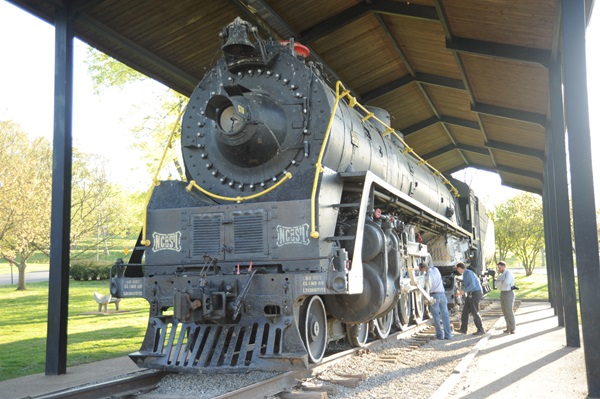
The Nashville, Chattanooga, and St. Louis railroad locomotive 576, was built around 1930, and was put into service soon thereafter. These particular locomotives, are known as "Dixie" locomotives, due to their large size. 576, is the last of its kind. She weighs 31,000 tons, and has a 15,000 gallon water tank. During its time in service, it was used to haul various cargo, most notably oil. During World War II, it transported soldiers to and from war. 576, was eventually retired and in September 1953, it was put on display in Nashville's Centennial Park. The Nashville, Chattanooga, and St. Louis Railway, in 1957, was absorbed by the Louisville and Nashville Railway. There have been many efforts to restore 576 to its former glory. Just this past week, the Metro Nashville government has approved an 8.5 million dollar project to remove 576 from the park, and restore it. It will be restored at the Tennessee Central Railway Museum. It should remain in the park until further notice, so I encourage those who are in the area to stop by and pay her a visit. When completed, it will be a great addition to the city of Nashville.


 Nashville, Chattanooga, and St. Louis Railway marker in Centennial Park.

This picture should give the reader an idea of just how big 576 is. 

When 576 was retired, and the NC & STL merged with the L&N, locomotives like the one above were put into service. They were simply more cost effective.

http://www.tennessean.com/story/news/local/2016/08/19/nashvilles-centennial-park-train-okd-restoration-operation/88966110/
Click the link above for an article detailing the plan for 576 to be restored.


Stay tuned for more blog posts about tales from Tennessee and beyond, and also for my big announcement.


Thursday, August 18, 2016

The Centralia Massacre


The Centralia, Missouri Massacre occurred on September 27, 1864. William "Bloody Bill" Anderson, and twenty-four other men, including Jesse James, rode into town, and completely sacked it. The men were dressed in Union military uniforms, that they had stolen. When they reached the town, they set to work tearing up railroad tracks. They then looted the rest of the town. These men took everything that was valuable. It is reported that they even drank their whiskey from boots, which they had stolen. Anderson and his men then blocked the railroad to prevent the oncoming train from passing through town. The engineer thought nothing was out of place, since the guerrillas were wearing Union uniforms. Once the train stopped, the guerrillas converged onto the train. There were 125 passengers in all, with twenty-three of them being Union soldiers. Anderson and his men ordered the soldiers off the train, and told them to take off their uniforms. The soldiers were then lined up along a wall. Anderson ordered the leader of the unit to step forward. Sergeant Thomas Goodman did so, Anderson ignored him completely, and he and his men commenced shooting the soldiers. Once they were dead, the soldiers were maimed and scalped. The locomotive was set on fire and sent down the tracks toward Sturgeon, Missouri. The guerrillas then set fire to the depot. Goodman was taken prisoner by Anderson, but later escaped as the men were crossing the Missouri River. Union Major A.V.E. Johnston pursued the guerrillas, but he and his band were unsuccessful. The guerrillas engaged them in a battle, and Johnston was shot by Jesse James. The events surrounding Centralia, Missouri, proves that the Missouri-Kansas area during the Civil War, was a hot bed for guerrilla warfare.

William "Bloody Bill" Anderson

Jesse James

SGT Thomas Goodman

Monument for the Centralia Massacre, and the battle that followed.

The book Bloody Bill Anderson, has an entire chapter devoted to the Centralia Massacre.


Stay tuned for more blog posts about tales from Tennessee and beyond, including the big announcement.


Monday, August 15, 2016

The Tennessee Central Railway


The Tennessee Central Railway was founded in 1884 by Jere Baxter. The original intent of the line was to transport coal throughout various towns. The route ran from Hopkinsville, Kentucky to Harriman, Tennessee. At the railway's peak, it covered 296 miles. The base for the Tennessee Central was located in Nashville, Tennessee. It was here, that offices, maintenance shops, locomotives, and train cars were housed. The railway system consisted of individual towns, with a depot in each. Over the years, the TC gained and lost various rail lines. The railway also underwent numerous changes in ownership. In July 1946, the railway changed ownership, and with it, the type of locomotives that were used. In an effort to keep costs down, the TC made the switch from steam powered locomotives to diesel powered ones. The TC ran passenger trains until 1955, this led to the closure of various depots, including the "Crown Jewel of the TC," the Cookeville Depot. The reason for this discontinuance in service was the automobile. People did not want to wait around for a train, when they could get in a car and have their own schedule. As the 1960s came, prices on coal began to drop. This eventually led to the closure of the railway in 1968. Most of the lines were absorbed by the Louisville and Nashville Railway. Most towns along the route chose to demolish their depots. The rail yard in Nashville eventually became a museum, that is still in operation today. Most of the locomotives and rail cars were sold, but a few were kept. Those that were kept have been put on display at the Tennessee Central Railway Museum, in Nashville. It is through the preservation efforts of many, that the legacy of the Tennessee Central Railway lives on.

Map of the entire Tennessee Central Railway.

Jere Baxter, founder of the Tennessee Central.

The Tennessee Central Rail yard in Nashville, as it appeared in the railway's heyday.

Locomotives, like 509, were used by the Tennessee Central until the ownership change in 1946. Sadly many of them have been scrapped. The red caboose behind 509, is known as "TC 9828."

After the 1946 ownership change, most of the diesel locomotives that were purchased were "alco" cabs, with a "streamline" design This particular one, is still in operation today, it pulls the annual Fall excursion trains.

The Tennessee Central also purchased locomotives like the one above. Known as "switchers," they rarely left the yard. They were used to make sure that the correct cars and cargo were connected to the correct trains.

The Tennessee Central Railway Museum, is involved in the restoration of locomotives and train cars. Above is one of their many projects.

The Tennessee Central Railway Museum is home to actor Jackie Gleason's personal train car. All of the TC's passenger cars are "streamline" design.


Stay tuned for more blog posts about tales from Tennessee and beyond, including my big announcement.