Thursday, December 28, 2017

Carnton Plantation


The Carnton Plantation is the most famous site that was associated with the 1864 Battle of Franklin, Tennessee. It was completed in 1826, and inhabited by the Randal McGavock family. McGavock had come to Tennessee from Virginia and became a prominent politician. He had served a one year term (1824) as Mayor of Nashville. He became close friends with both Andrew Jackson and James K. Polk. Both men and their families were often guests at Carnton. McGavock's daughter Elizabeth later met and married William Giles Harding of the nearby Belle Meade Plantation. All of these families all became intertwined, and if one pays attention to street names in and around the Nashville area, you will see the names of these families. Randal McGavock named his new house and land Carnton after his father's birthplace in County Atrium, Ireland. The name Carnton comes from the root word "cairn," which means "a pile of stones." McGavock constructed his home in the Federal architectural style. Carnton was constructed of brick, following the lead of Thomas Hardin Perkins and his Meeting of the Waters. When Randal McGavock passed away in 1843, Carnton was left to his son John and his wife/cousin Carrie. The younger McGavock quickly set to work putting his own touches on Carnton. Due to the rise of the Greek Revival architectural style, John McGavock added a full height entry porch to the main facade of the home, along with a transom and side lights. On the rear elevation he added a full facade porch. This porch was designed so that the house would benefit from a strong southerly wind. Inside, McGavock updated Carnton with wallpapers and carpets popular for the time. He made sure to keep his father's designs intact while putting his own touches on Carnton. John McGavock also put his touches on the landscape architecture of Carnton. He planted cedar trees along the driveway leading to the house. He also designed a one acre garden to the west of the house that was based on the writings of Andrew Jackson Downing. McGavock, like his father, continued to use the plantation for agricultural production. Crops grown on the plantation included wheat, corn, oats, hay, and potatoes. At its peak Carnton consisted of 1,400 acres of land, 500 of which was used for agricultural production. When the Civil War broke out, McGavock was forty-six and to old to fight. Instead he helped outfit Southern troops, and he helped recruit soldiers. His wife Carrie worked as a seamstress. By 1864, as the fighting got closer to home, McGavock sent his slaves to Louisiana so they would not be seized. When Middle Tennessee fell into Federal hands, crops and livestock were seized from Carnton. Following the 1864 Battle of Franklin Carnton became the largest temporary field hospital in the area. Approximately 300 soldiers were cared for inside the McGavock family home. Approximately 150 of them died the first night they were there. Members of the family assisted the doctors and surgeons in any way they could. Blood from various surgeries and open wounds spilled out onto the floor and carpets of the home. These stains were never removed, and are visible today. General John Schofield and his Confederate army had no time to stay and bury the dead. The McGavock family and citizens of Franklin were faced with having to bury over 2,500 deceased soldiers. The soldiers were buried as best as they could be based on where they were from. Headstones were made out of wood from bed headboards. Over time these boards began to rot. John and Carrie McGavock donated two acres of their plantation for a new cemetery. The soldiers were exhumed and reburied on the McGavock family plantation. A total of 1,481 soldiers and one civilian were buried in the two acres given by the McGavock family. George Cuppett and Carrie McGavock made sure that all the names of the soldiers interned in the McGavock Cemetery were recorded in a book. This cemetery serves as a reminder today of what the Franklin community went through during the Civil War, and its location near Carnton serve as a reminder of the role the home played immediately following the battle. Following the Civil War, John McGavock continued to use Carnton for agricultural production. His former slaves were given sharecropping opportunities. When he passed away in 1893, Carrie McGavock took over management of the plantation and the cemetery. The cemetery was her pride and joy and she cared for it faithfully until her death in 1905. Son Winder McGavock inherited Carnton following the death of his mother. Sadly he died in 1907, and his widow and children left Carnton. In 1909 a tornado destroyed the eastern section of the house, and in 1911 Winder McGavock's window sold the house and property. For the first time in one hundred years Carnton was not owned by a member of the Carnton family. Various people owned Carnton in the following years, and by the late 1960s and early 1970s the house had fallen into neglect. In 1977 the Carnton Association was formed to raise money to purchase, and restore the house. In 1978 Dr. and Mrs. W.D. Sugg donated the home to the Carnton Association. A full restoration of the house, plus purchase of an additional thirty-eight acres of land was completed in the early 1990s. In 1973 Carnton was listed on the National Register of Historic Places. Today the Carnton Plantation operates under the oversight of the Battle of Franklin Trust. This organization is entirely self supporting, receiving no funds from local, state, or the Federal government. The Carnton Plantation serves as a somber reminder of the Civil War and the Battle of Franklin. The Carnton Plantation is also a perfect example of historic preservation success. However for every Carnton there are thousands of historic sites that still need to be preserved. At Moore Historical Consulting historic preservation is my #1 priority. Do you know of a site that needs to be preserved? If so contact Moore Historical Consulting today to learn more and get started.

Blood stains on the floor of Carnton serve as a somber reminder of the events following the 1864 Battle of Franklin.

The McGavock Cemetery also serves as a somber reminder of what Carnton witnessed in 1864.


This New Year why not make a resolution to yourself to finally uncover more about your families history? More about your property? Or if you are the owner of an historic home or building, why not make 2018 the year you decide to list it on the National Register of Historic Places? Moore Historical Consulting is able to assist you with all of these projects, contact me today to learn more and get started. I make exploring your past fun and easy!!

Thursday, December 21, 2017

Meeting of the Waters


Meeting of the Waters was constructed in the early 1800s by Thomas Hardin Perkins. Perkins had received this land, located in Williamson County, Tennessee, as a land grant for his service in the American Revolution. The land intersected the Big Harpeth and West Harpeth Rivers. This is where the name "Meeting of the Waters" comes from. Perkins constructed his home in the Federal architectural style. He also bricked the house, making Meeting of the Waters one of the first homes in Tennessee to feature brick. The geography of the land is interesting as well. At this time Williamson County was out on the frontier. The nearest city (Franklin) was five miles away. Getting there took the better part of the day. The Perkins family had to grow their own crops, and always be on the lookout for Indians. As the city of Franklin began to grow, Meeting of the Waters remained in rural Williamson County. When Thomas Hardin Perkins died in 1838, Meeting of the Waters was passed down to his daughter, Mary Hardin Perkins, and her husband and cousin Nicholas "Bigbee" Perkins. They operated both Meeting of the Waters, as well as the plantation they had settled, known as Montpier. "Bigbee" became well known in Tennessee for assisting the Federal government in locating and capturing Aaron Burr. "Bigbee" enjoyed elaborate items, and furnished Meeting of the Waters in such a way. Meeting of the Waters has even more historical significance due to the fact that Franklin's founder Abram Maury's granddaughter married Perkins' grandson. In 1864, when the Battle of Franklin occurred, Meeting of the Waters most likely served as a camp site for both sides due to its location beside the two rivers. There are no records that suggest the house or land around it played host to any fighting, or was ever used as a headquarters. Those honors belong to the Carter, and Lotz houses, and the Carnton and Rippavilla plantations. Eventually Meeting of the Waters was sold out of the Perkins family. It has since had various owners, and is currently for sale. In 1982 Meeting of the Waters was added to the National Register of Historic Places. Meeting of the Waters is often referred to as "one of the finest homes built in the county before 1830," and has also been dubbed "queen of Williamson County's historic plantation houses." The Perkins family, and those who have come later deserve much credit for keeping this magnificent home preserved. Hopefully the next owner will continue the great historic preservation success of Meeting of the Waters. At Moore Historical Consulting I am committed to historic preservation and growing the National Register of Historic Places. Do you know of an historic site that needs to be preserved, and/or is eligible for the National Register? If so, contact Moore Historical Consulting today to learn more and get started.

Williamson County Historical Society historical marker at Meeting of the Waters.


Link to Meeting of the Waters real estate listing: https://www.zillow.com/homedetails/3200-Del-Rio-Pike-Franklin-TN-37069/42621924_zpid/


Be sure to come back next week for another Throwback Thursday courtesy of Moore Historical Consulting. Are you interested in heritage management? historic preservation? or historic litigation? If so contact Moore Historical Consulting today to learn more and get started. I make exploring your past fun and easy!!

Thursday, December 14, 2017

Travellers Rest


Travellers Rest was constructed in 1799 by Judge John Overton. Overton had come to Nashville, Tennessee from Virginia. He was an attorney by trade. He settled just south of Nashville. He originally called his plantation Golgotha. This was due to the fact that while digging the cellar for the home, several prehistoric skulls were discovered. Recent findings by archaeologists have determined that these skulls are from a large Mississippian village. Overton designed and constructed his new home in the Federal architectural style. This architectural style had been popular in the 13 colonies, and was gaining popularity as settlers moved westward. Travellers Rest is one of only a few remaining historic homes that feature this architectural style. The name Travellers Rest was given to the plantation in the early 19th century by Overton. He wanted the name to reflect the fact that he was able to rest and relax here after a long period of circuit riding. Overton's law career allowed him to do many things outside of Travellers Rest. In 1804 he was elected to the Tennessee Supreme Court to succeed his good friend Andrew Jackson. He served in that capacity until 1810. In 1819 Overton, Jackson, and James Winchester took land they jointly owned in the southwestern part of the state, and established Memphis. In 1820 Overton married Mary McConnell White. White had recently been widowed and left with five children to raise. Overton added on to the rear of Travellers Rest to accommodate them. Together Overton and White would have three children of their own. On April 12, 1833 John Overton passed away peacefully at Travellers Rest. At this time of his passing Travellers Rest consisted of a total of 2,000 acres. Mary Overton continued to live at Travellers Rest until her death in 1862. During the Civil War Travellers Rest served as headquarters to both Union and Confederate forces. Following the war John, son of Mary and Judge Overton, and his wife Harriet continued to oversee operations of the plantation. When they died their son John Overton II acquired the property. In 1887 he renovated the rear addition, adding a room upstairs and one downstairs. The home and property remained in the possession of the Overton family until 1946. The acreage dwindled over time as those who inherited it sold it. The first family to possess Travellers Rest and its adjacent lands was Dr. John Youmans. Youmans was a professor of medicine at Vanderbilt University. In 1951 he sold the home and property to the Louisville and Nashville Railroad. Youmans encouraged the railroad to donate the property to an historic preservation minded group. The Colonial Dames eventually stepped in and acquired the site. In 1989 they leased the site to a new group known as Travellers Rest Historic House Museum Incorporated. Together the two groups have turned the home and surrounding land into a lovely museum. The group prides themselves on the fact that Travellers Rest is the oldest house museum open to the pubic in Nashville. On December 30, 1969 Travellers Rest was added to the National Register of Historic Places. At Moore Historical Consulting I am committed to growing the National Register. I am also committed to historic preservation. For every Travellers Rest there are still thousands of homes just like it that need to be preserved. Do you know of one? If so contact Moore Historical Consulting today to get started.

Judge John Overton

Rear addition to Travellers Rest.

Smokehouse at Travellers Rest.

Modern barn used to host weddings and other events.

Tennessee Historical Commission historic marker at Travellers Rest.


Be sure to come back next week for another Throwback Thursday courtesy of Moore Historical Consulting. This Christmas why not give the gift that will last a lifetime? At Moore Historical Consulting I offer various heritage management strategies. Contact me today to learn more and get started. I make exploring your past fun and easy!!

Thursday, December 7, 2017

Fort Negley


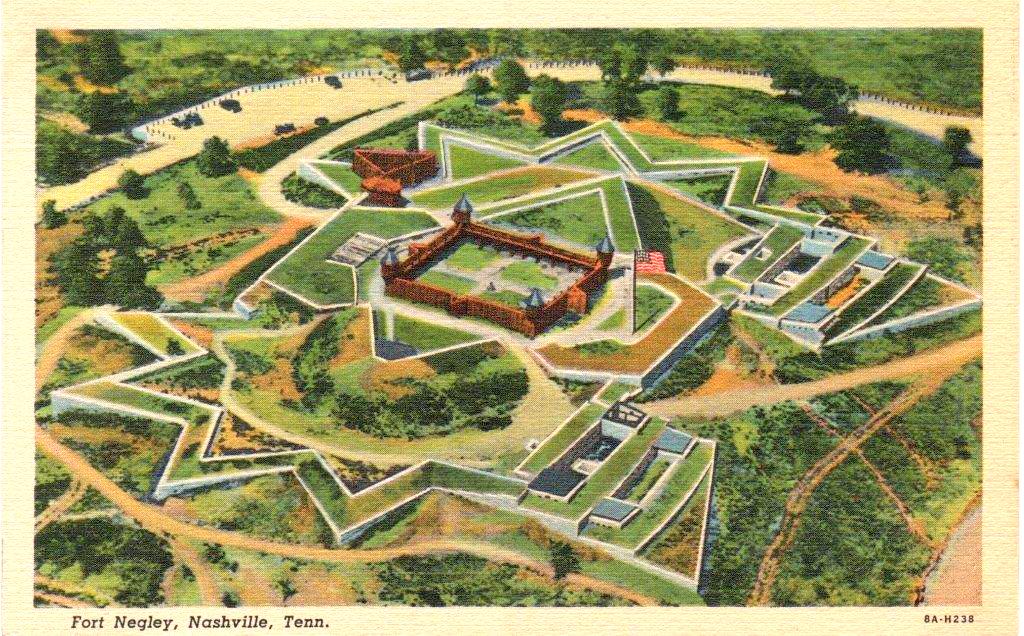
Fort Negley was constructed in 1862 by the Union army to protect Nashville, Tennessee during the Civil War. Nashville was one of the first cities in the Confederacy to fall into Union hands. Military Governor Andrew Johnson did not want to risk the Confederate army recapturing the city. Fort Negley was constructed south of Nashville atop St. Cloud Hill. From the top of this hill, the troops could see for miles. The fort was named for Union Army commander General James S. Negley. The fort was constructed in a "star" shape. Used in the fort's construction was 62,500 cubic feet of stone, and 18,000 cubic feet of earth. Both enslaved, and freed slaves helped construct the fort. During the construction process approximately 600-800 people died. The cost of construction was $130,000. The fort was commanded for the entirety of the war by Captain James St. Clair Morton. In 1864, during the Battle of Nashville, Fort Negley did not play a major role. All the fighting happened further south.  When the Civil War ended in 1865, the fort fell into ruin. Ironically the fort was used by the Ku Klux Klan as a meeting place. In the 1930s, the Works Progress Administration made an effort to restore the fort, and make it into a museum. This project was barely completed when World War II broke out.  When the war ended, the site fell back into ruin. Fort Negley became the site of both vandalism and gang activity. Areas around the site were developed. Among the most notable of these new developments were the Adventure Science Center, and Greer Stadium. Finally on December 20, 2004, the Fort Negley site was opened to the public. The preservation project did not restore the fort to its original appearance, but instead it was an effort to stabilize its ruins. A visitor's center was also constructed. In 2015, the Nashville Sounds minor league baseball team left Greer Stadium and moved into a new ballpark. This raised the question about what to do with the now vacant Greer Stadium. In 2017 it was announced that the City of Nashville would raze the old stadium and use the site to highlight Fort Negley's history. The goal is to eventually have interpretive trails, and also to restore many of the fort's original sight lines. Greer Stadium, due to its close proximity to Fort Negley is believed to be sitting on the graves of African-American slaves and freedmen who helped construct the fort.  At the time of this writing, archaeologists are in the process of studying the stadium site to see if there are indeed graves there. If there are indeed graves found it will only make the site more valuable to our learning about the history of Fort Negley, and Nashville. Fort Negley is, and continues to be a great example of historic preservation success. At Moore Historical Consulting historic preservation is my passion. I am 100% committed to this practice. Do you know of a building, site, or home that needs to be preserved? If so contact me today!!

Fort Negley today.

Artist rendering of Fort Negley at its peak.

Entrance to the Fort Negley site.

The now closed Greer Stadium. Currently being studied by archeologists to see if graves of slaves who built Fort Negley are underneath.


Be sure to come back next week for another Throwback Thursday courtesy of Moore Historical Consulting. With Christmas right around the corner, why not give the gift that will last a lifetime? I offer many heritage management strategies, such as genealogy, and business history. Contact me today to learn more and get started. At Moore Historical Consulting I make exploring your past fun!!

Thursday, November 30, 2017

Burra Burra Mine


The Burra Burra Mine takes its name from the famous mine of the same name in Australia. Located in Ducktown, Tennessee, it operated from 1899-1959. The area where the mine is located is at the center of the "copper basin." This basin consists of areas in Tennessee, Georgia, and North Carolina. The Ocoee River flows through the southwestern portion of this area.  The Burra Burra Mine is located approximately 1,798 feet above sea level. The land that now comprises the "copper basin" were Cherokee lands until 1836, when the Federal Government took control of the basin. In 1843, copper was discovered for the first time. However, it was difficult to access due to the lack of major roads. In 1850, the current US-64 was constructed through the Ocoee Gorge, and in 1860, the Burra Burra Copper Company was established. Mining operations did not last long, due to the outbreak of the Civil War. Following the war, costs of transporting copper out of the mines became so expensive that the Burra Burra Copper Company was forced out of business. By the early 1890s, the Marietta and North Georgia Railroad, and the Knoxville Southern Railroad constructed a rail line that connected the copper basin to both Knoxville and Marietta. This provided an easy way to transport copper, and put the mines back in business. The mines were overseen by the Tennessee Copper Company. The Burra Burra Mine used an open roast smelting method. This method released large amounts of sulfur dioxide. This resulted in the killing of vegetation throughout the central basin. After a lawsuit by local farmers, and the State of Georgia, the Tennessee Copper Company began to recapture the sulfur dioxide, and convert it into sulfuric acid. This sulfuric acid was then sold. In addition to producing copper, and sulfuric acid, the mines also produced copper sulfate, as well as iron, and zinc concentrates. By the time the Burra Burra Mine closed, its vertical shaft was over 2,400 feet deep. This made it one of the largest, and deepest vertical shafts in North America. Even though the Burra Burra Mine closed in 1959, mining continued in the "copper basin" until 1987. In 1988, concerned residents wanted to do something to honor their mining history. They petitioned the state of Tennessee to purchase the old mine site. The state did, and the Ducktown Mining Museum was established. As part of a "re-greening" effort approximately 16 million trees have been planted at the Burra Burra Mine, and the area has been seeded with acid tolerant grass. Only ten structures remain from the original mine. The mine itself has since collapsed, and has filled with water. The site has been listed on the National Register of Historic Places. The site is currently under the oversight of the Tennessee Historical Commission. The Burra Burra Mine, and its buildings are yet another great example of historic preservation success. At Moore Historical Consulting, historic preservation is, and will remain my #1 priority. For every saved site, there are thousands more that have yet to be saved. Do you know of one? If you answered yes, contact Moore Historical Consulting today.

The Burra Burra Mine today.

A few of the remaining Burra Burra Mine buildings.

The Tennessee Historical Commission puts these signs at all their State Historic Sites.


Be sure to come back next week for another Throwback Thursday presented by Moore Historical Consulting. Christmas is right around the corner. Why not give the gift of heritage management this year? Moore Historical Consulting offers a variety of genealogy, and business, and property history services. Contact me today to learn more. Moore Historical Consulting makes exploring your past fun and easy!!

Thursday, November 16, 2017

Belle Meade Plantation


Belle Meade traces its history back to 1807, when Virginian John Harding bought land, and a cabin along the Natchez Trace. The land totaled 250 acres. Harding did not use this land for farming. He instead used it for commercial purposes. He operated a blacksmith shop, cotton gin, and a grist and saw mill. By 1816 Harding was boarding horses for area residents such as Andrew Jackson. He also raised racing horses and became a member of the Nashville Jockey Club. He built the Belle Meade house in 1820. The house originally featured federal style architecture. Harding named the house and his land Belle Meade due to its French meaning as "beautiful meadow." In 1839, Harding's son William took over operations of Belle Meade. He expanded the plantation from 250 to 5,000 acres. In 1853 he enlarged the mansion. He also changed the architectural style from Federal to Greek Revival. This was not uncommon in the 19th century, as many homes were converted into the Greek Revival architectural style. The younger Harding felt that the new architectural style reflected the success of the plantation. The fourteen foot high central entrance hall was designed to run east to west, allowing for natural cooling. This same central hall configuration is found on the second and third floors as well. Belle Meade is also unique because it was one of the first homes to be equipped with a basement. Belle Meade functioned normally until 1861 when the Civil War broke out. William Harding was quick to side with the Confederate Army, donating $500,000 to their cause. When Nashville fell to the Union in 1862, Harding was arrested, and sent to Fort Mackinac, Michigan. He was held there for six months. Back at home, Belle Meade was playing a vital role in the Battle of Nashville. Confederate General James Chalmers used the mansion as his headquarters. Union and Confederate armies engaged in a minor skirmish on the front lawn of the plantation. Bullet holes are still visible in the columns on the mansion's main facade. Following the Civil War, Belle Meade once again became a leader in horse training and racing. In 1868, Harding's daughter Selene married former Confederate General William Hicks Jackson. Harding would only let them get married if they agreed to stay on the plantation. The couple agreed, and they helped Harding run Belle Meade. Eventually Harding and Jackson decided to get out of the racing business. They instead decided to focus on breeding. They decided to sell  breeding stock of ponies, Alderney cattle, Cotswold sheep, and Cashmere goats. They also maintained a 600 acre deer park. Belle Meade stayed in the Harding family until William Jackson's death in 1903. Due to adverse financial conditions, the family sold the house and property. Most of the property was purchased and developed into modern residential neighborhoods by the Belle Meade Land Company. In 1938, these new neighborhoods were incorporated into the City of Belle Meade. The Belle Meade mansion saw a slew of different owners. It remained a private residence until 1953, when the State of Tennessee purchased it, and its 30 acres. The state deeded the property to the Association for the Preservation of Tennessee Antiquities, who oversee it today. Besides the mansion, other buildings on the grounds include the original cabin from 1807, carriage house, stable, and reconstructed slave quarters. On December 30, 1969 Belle Meade was added to the National Register of Historic Places. Belle Meade is regarded by many historians as the "Queen of Southern Plantations." For every Belle Meade there are thousands of sites just like it that are in need of preservation. At Moore Historical Consulting, historic preservation is my top priority. I am always looking for potential sites to help preserve, and list on the National Register of Historic Places. Do you know of one? If so contact Moore Historical Consulting today to learn more and get started!!

Interior of the Belle Meade mansion.

Original cabin that John Harding purchased in 1807.

Reconstructed slave quarters.

Belle Meade carriage house.

Belle Meade stable.

Many of the modern homes in the Belle Meade community feature much of the same architectural styles as the historic Belle Meade mansion. 


Due to the Thanksgiving holiday next Thursday, there will NOT be a Throwback Thursday. Moore Historical Consulting would like to wish everyone a safe and happy Thanksgiving. Whether your need is genealogy, property research, historic litigation, historic preservation, or anything in between, put Moore Historical Consulting to work for you today. I make exploring your past fun and easy!!

Thursday, November 9, 2017

Rippavilla Plantation


Construction began on the Rippavilla Plantation in 1851, by Nathaniel Cheairs IV. The Cheairs family had lived in the Spring Hill, Tennessee area since 1811. Construction was not complete until 1855, due to the fact that the Cheairs family had construction halted three separate times. Each time, Nathaniel Cheairs was unhappy with how the house was being constructed. While the house was under construction, the Cheairs family lived in a two story log cabin on the property. The family finally moved in in 1855. Once completed, the new home featured a full height entry porch, in the Greek Revival architectural style. The home also featured four fireplaces. The interior was decorated with elaborate wallpaper, flooring, and furnishings. A slave cabin was constructed behind the house. It is unknown how the plantation received its name. Their stay did not last long however. Following the outbreak of the Civil War, in 1861, the family moved out. Nathaniel Cheairs raised two companies of men for the Confederate Army. Cheairs rose to the rank of "major." At the Battle of Fort Donelson, Cheairs delivered General Ulysses Grant's "unconditional surrender" to General Simon Buckner. In 1864, during General John Bell Hood's last gasp effort to take back Tennessee, Rippavilla served as his headquarters before the Battle of Franklin. After the battle, Rippavilla served as a field hospital. The home had also served as headquarters to Union troops. On the front porch of the house, it is believed that Nathan Bedford Forrest threatened to beat up Hood. When the war ended, the Cheairs family moved back to Rippavilla. Nathaniel and his wife Susan continued to reside at Rippavilla until her death in 1893. Nathaniel suffered a stroke while visiting family, and died soon after in 1914. His son William took possession of Rippavilla. The younger Cheairs maintained possession of the home until 1920, when he sold it. Between 1920 and 1997, not much is known about the house, or who occupied it. Large modern developments sprang up on all sides, but the historic Rippavilla home stood the test of time. In 1997 the home was restored by the Saturn Corporation, whose plant was right across the street, the United Auto Workers Association, and the Maury County government. Rippavilla was added to the National Register of Historic Places in 1996. Today the Rippavilla Plantation consists of only 98 acres. The slave cabin is still extant, and many of the slaves who worked on the plantation are interned in a slave cemetery on the property. In May of 2017, the City of Spring Hill accepted the donation of the Rippavilla Plantation, by Rippavilla Incorporated. The city government will oversee the continued preservation and maintenance of the home and grounds, while the Friends of Rippavilla will continue to oversee fundraising efforts. The Rippavilla Plantation is truly a great historic preservation success story. At Moore Historical Consulting, my #1 priority is historic preservation. For every Rippavilla, there are countless other historic properties that need immediate attention. It is also vital to continue to preserve, maintain, and promote historic sites that have already been saved. Do you know of an historic site that needs attention? If so contact Moore Historical Consulting today to get started.

Rippavilla home during the Civil War.

Interior of the Rippavilla home.

Slave cabin at Rippavilla.

Slave cemetery at Rippavilla.

Tennessee Historical Commission historical marker at the Rippavilla Plantation.


Be sure to come back next Thursday for another Throwback Thursday presented by Moore Historical Consulting. At Moore Historical Consulting, I make exploring your past fun!!